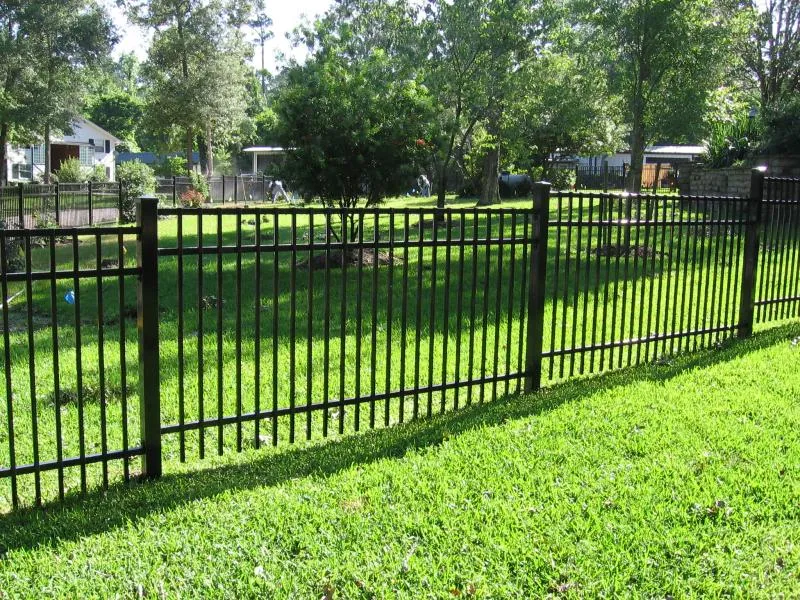
Yes. A fence on sloping ground is either racked, with the rails angled to match the grade, or stepped, with level panels that drop one after another. Chicago is flat, so real slopes are rare, but raised yards, sunken gangways and lots that fall toward an alley all need one of the two.
Racked or stepped: which is better?
- Racked: the rails follow the ground and the pickets stay plumb. The gap underneath is the smallest, so pick it for dogs and gentle grades.
- Stepped: each panel is level and the next one sits lower. It works with stiff panels and bigger drops, and it leaves a triangle of space under every panel.
- Built in place: every board is cut to meet the ground. It is the slowest method and the closest fit for a wood fence.
I have a dog that digs and a yard that drops. How do I avoid gaps?
Ask for a racked or built-in-place fence so the bottom tracks the ground, and then close off the base. Options are a treated kick board, pickets cut to the grade, or wire mesh buried below the fence. With chain link, a bottom rail or a tension wire stops the dog pushing the mesh outward.
My yard is steep and rocky and two companies turned the job down. Who does this?
Call us. We look at the line in person before we answer. In Chicago, hard digging is almost never bedrock. It is stiff clay, large roots from old trees, or brick, cinders and concrete buried when an earlier garage or building came down. We break those out or move a post a short way along the line. It is slow work, and it can only be priced after we see it.
Do installers dig by hand or with a machine?
Both, depending on the spot. A power auger is quick in an open back yard. Many city jobs are hand dug anyway, because a machine will not fit through a 3-foot gangway. We also dig by hand near marked utilities, against house and garage walls and around roots.
The real price comes from a free visit and a written quote. Call (773) 741-0364 or text us a photo of the fence line.